Marine biologist Ayana Elizabeth Johnson asks a question I can’t stop turning over, what would it look like if we actually lived as if we loved the future? Not hoped for it. Loved it, the way you’d protect something you were attached to.
I used to think hope was the goal. Johnson’s answer, in her book What If We Get It Right?, is different. Hope assumes an outcome. What she argues for instead is possibility, the idea that the future isn’t locked in, and that the range of what could still happen is wider than most climate conversations make it feel. She’s a marine biologist, the co-founder of a think tank called Urban Ocean Lab, and someone who has spent years working specifically on ocean and coastal policy. When she talks about possibility, she’s not talking in the abstract. She’s talking about mangroves.
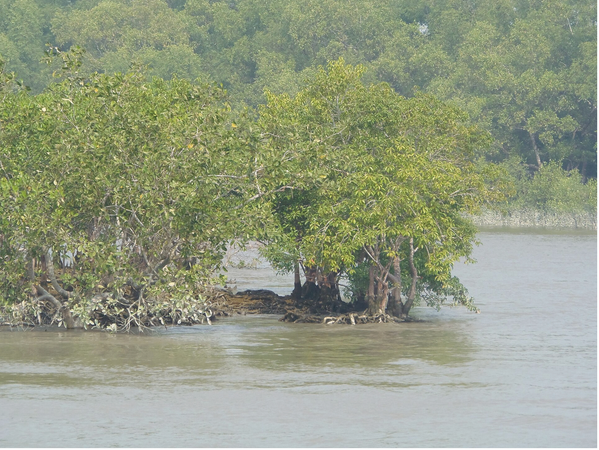
Mangroves are the coastal forests that grow where salt water meets land, roots tangled directly in tidal mud. I didn’t know until recently how disproportionate their carbon storage actually is. According to NOAA, mangroves and salt marshes store three to five times more carbon per acre than tropical rainforests, and they pull carbon out of the atmosphere at a rate up to ten times faster. A forest research group at the Smithsonian found similar numbers, mangrove soils alone can hold up to four times the carbon of equivalent land forest, mostly buried underground where it can stay locked away for centuries instead of decades.
That number sat oddly with me at first, because mangroves don’t look like the kind of forest that gets treated as a climate priority. They’re not majestic in the way a rainforest canopy is. They’re low, tangled, muddy, half underwater at high tide. But that mud is exactly the point. Blue carbon researchers, the term for scientists who study carbon storage in coastal ecosystems, have found that waterlogged mangrove soil starves off the oxygen that would normally let buried plant matter decompose and release its carbon back into the air. The mess is the mechanism.
And mangroves do more than store carbon. They buffer coastlines against storm surge, give fish nurseries to grow in before heading to open water, and filter pollution out of water flowing toward the ocean. Despite that, global mangrove cover has dropped by an estimated 30 to 50 percent over the last fifty years, mostly cleared for aquaculture ponds and coastal development, according to the Blue Carbon Initiative. Every acre lost doesn’t just stop storing new carbon. It can release the carbon already buried in that soil back into the atmosphere.
Johnson’s version of possibility isn’t abstract optimism layered on top of a bad situation. It’s specific, restore mangrove forests, support regenerative ocean farming, build coastal communities that work with tidal ecosystems instead of paving over them. None of it requires new technology. Most of it requires deciding that a muddy tangle of roots is worth protecting as seriously as we’d protect a rainforest, even though it doesn’t photograph the same way.
Protecting what protects us isn’t a metaphor here. It’s closer to a literal description of how a mangrove root system works.
Sources. Johnson, A.E., “What If We Get It Right?”; NOAA; Smithsonian forest research group; Blue Carbon Initiative.