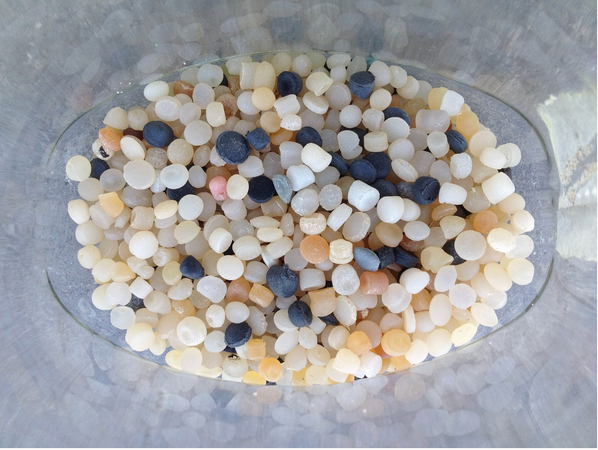
Two facts from a recent lesson stuck with me more than I expected. The first is just how much of the plastic economy runs on something almost nobody has heard of. The second is that this same thing is small, round, and pale enough that a fish will eat it thinking it’s breakfast.
They’re called nurdles. Lentil sized pellets of raw plastic, melted down to make nearly every plastic product that exists, water bottles, car parts, food containers, all of it starts as a pile of these things before it becomes anything recognizable. There’s a citizen science project in Scotland called the Great Nurdle Hunt, run by an environmental charity named Fidra, that has spent over a decade sending volunteers out to count nurdles on beaches. Their numbers are hard to sit with. An estimated 445,970 tonnes of nurdles escape into the environment worldwide every year, mostly from spills during transport and ordinary handling at factories, before the plastic has even been used to make anything.
The part that got me was the fish egg thing. Nurdles are close enough in size and color to fish eggs that marine animals genuinely cannot tell the difference. They eat them. And because plastic pellets sitting in water act like little sponges for toxic chemicals, PCBs, PFAS, whatever happens to be floating nearby, an animal that eats a nurdle isn’t just swallowing plastic. It’s swallowing a concentrated dose of whatever pollution has attached itself to that pellet over time, chemicals that then move up the food chain every time something eats something else.
After a pellet spill near a beach in northeast England, Heather McFarlane, a senior project manager at Fidra, described nurdles as devastating and very difficult to clean up. Once they escape a spill site, she said, they spread fast, and they end up affecting local wildlife, fishing and tourism, not just the immediate mess. Her point wasn’t that this particular spill was unusual. It was that this keeps happening, and most of it is preventable with basic changes like better packaging and safer storage during shipping.
That last part is what actually gives me some hope here, more than most plastic pollution stories do. This isn’t a problem that requires inventing new technology. Fidra’s own solutions page is almost boring in how straightforward it is, standardized handling practices across the supply chain, spill containment at factories, filters in drains at sites where pellets are processed, stronger regulation with real penalties for losses. None of it is complicated. Most of it is just discipline that isn’t currently required by law in most places.
On my end, there isn’t much I can personally do about shipping regulations. What I can do is pay attention to how much plastic packaging I’m buying in the first place, since every piece of it started as pellets exactly like these, and join or support a beach cleanup that specifically looks for pellet pollution rather than just visible trash, since nurdles are small enough that most people walk right past them without noticing anything is there at all.
That’s sort of the whole problem, actually. You cannot fix pollution you don’t know how to see. Once you know what a nurdle looks like, you start noticing them everywhere, scattered across sand like something spilled from a salt shaker. Before that, you just see beach.
Sources. The Great Nurdle Hunt, Fidra; McFarlane, H., Fidra.