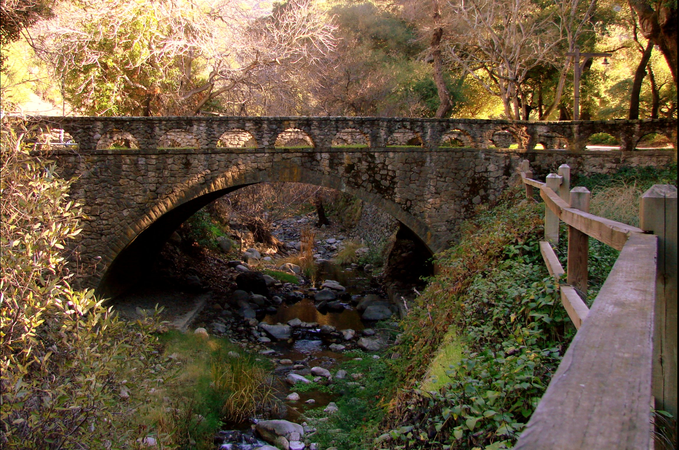
I have lived near Alum Rock Park most of my life and only recently learned it is the oldest municipal park in California, older than the state’s other famous parks, older than most of the buildings around it. It was established in 1872. Before that, it had already been public land since San Jose was founded as a pueblo in 1777.
720 acres, tucked into the Diablo Range foothills on the east side of the city. Thirteen miles of trails, some of them flat along Penitencia Creek, some of them steep switchbacks climbing to ridgelines. For nearly forty years, starting in 1890, it operated as a nationally known health spa, built around 27 natural mineral springs that people traveled specifically to visit. You can still see the old stone grottos where the springs were, even though the trail to them is currently closed for erosion.
What I didn’t know until I looked into it is how much work is currently going into keeping this place alive as the climate around it changes. The U.S. Forest Service awarded San Jose 6.6 million dollars in September 2023 to expand and restore tree canopy citywide, and about 1 million dollars of that is earmarked specifically for vegetation management and wildfire mitigation at Alum Rock and Overfelt Gardens. The work includes pruning, removing invasive species, and planting native trees that are more resilient to the kind of heat and drought stress that make wildfires worse.
That funding matters more than it might sound like, because San Jose’s tree canopy overall has actually been shrinking. City data cited by San Jose Spotlight found canopy coverage dropped by 2.7 square miles in recent years, and the city hadn’t even updated its tree inventory since 2014 as of the most recent community forest management plan. A park like Alum Rock, largely wild and largely intact, is an exception to a citywide trend, not proof the trend has been solved.
Rhonda Berry, CEO of Our City Forest, the nonprofit that plants most of San Jose’s new trees, put the stakes in blunt terms I haven’t stopped thinking about. If you’re outside without shade, she said, you’re basically inhaling tires, since so much of urban air pollution comes off tire wear and vehicle exhaust that trees would otherwise help filter and cool. To her, trees aren’t just scenery. She compares them to high tech infrastructure, filtering air, storing carbon, cooling neighborhoods, all quietly, all the time.
Alum Rock is also a protected wildlife sanctuary, which is why dogs aren’t allowed there, a rule I used to find inconvenient before I understood it’s specifically there to protect the black tailed deer, brush rabbits, and red tailed hawks that depend on the park staying undisturbed. It’s one of the only places inside city limits where that kind of protection actually holds.
None of this means the park is safe forever just because it’s old and protected on paper. Wildfire risk in California doesn’t respect a park’s founding date. What keeps 720 acres of oak woodland standing through more frequent droughts and hotter summers is exactly the kind of unglamorous maintenance work happening there right now, pruning, invasive removal, replanting with trees built for the climate that’s actually coming, not the one the park was designed for in 1872.
I’ve walked those trails without knowing any of this. I don’t think I’ll walk them the same way again.
Sources. U.S. Forest Service (2023 canopy grant); San Jose Spotlight; Berry, R., Our City Forest; City of San Jose Community Forest Management Plan.