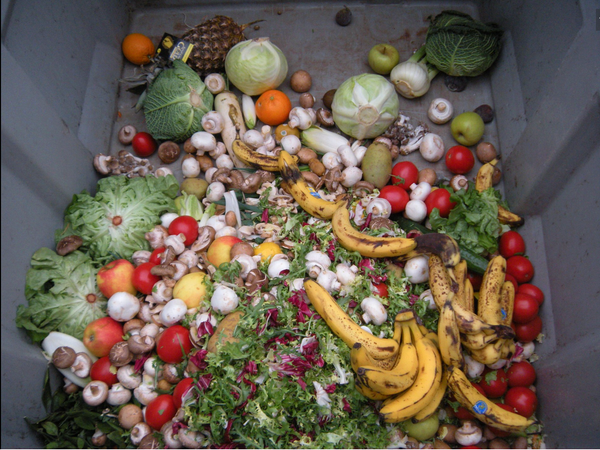
I weighed my food waste for 24 hours, expecting a small, forgettable number. It came out to 900 grams, close to two pounds, in a single day. About 71 percent of it, by my own count, was avoidable, forgotten leftovers in the back of the fridge, rice I’d cooked too much of, a curry that spoiled before anyone finished it, plates I’d portioned bigger than I actually wanted.
I grew up hearing waste not, want not, the kind of phrase repeated often enough in immigrant and working class households that it stops sounding like advice and starts sounding like a fact about the world. I genuinely believed I was living it. The scale disagreed.
Turns out I’m not unusual, which is both reassuring and a little damning. Research based on USDA loss adjusted food availability data estimates Americans waste roughly one pound of food per person, per day. My 900 grams works out to almost exactly double that national average, on a day I wasn’t even trying to be wasteful, just living normally.
Households aren’t a small part of this problem, they’re the biggest one. According to ReFED, a nonprofit that tracks food waste data nationally, households account for 37 percent of all food wasted across the entire US supply chain, more than restaurants, more than grocery stores, more than farms. Dana Gunders, a food waste researcher who has spent years studying this exact gap, put the scale of it in dollar terms that landed harder for me than the pound figures did, the average American family throws away roughly 1,500 dollars worth of food a year. As she’s put it, that’s not really about individual thriftlessness. It’s a symptom of a food system built around overproduction and under distribution, where growing and shipping more than anyone needs is cheaper than making sure less goes to waste in the first place.
That system framing matters, but it doesn’t cancel out what happens in my own kitchen. Producing the food that ends up wasted nationally requires an estimated 30 million acres of cropland and 4.2 trillion gallons of irrigation water a year, according to research published in the journal Environmental Science and Technology. Every ignored leftover in my fridge is a small claim on both of those numbers, water and land spent on food that never gets eaten.
The federal government has actually set a target here, USDA and the EPA jointly committed to cutting food waste 50 percent by 2030, a goal reaffirmed as recently as 2024. Meeting that target nationally depends on millions of individual kitchens doing something closer to what I’m trying to start now, which isn’t complicated. Storing greens properly instead of letting them wilt in a crisper drawer. Cooking the amount of rice I’ll actually eat instead of the amount that looks right in the pot. Turning yesterday’s curry into today’s rice bowl instead of leaving it in a container until it’s unsafe to eat.
None of that solves a system built around overproduction. It does mean the next 24 hour audit, if I run one, should read closer to 450 grams than 900. That’s a number I can actually move. The system is somebody else’s fix. My fridge is mine.
Sources. USDA loss-adjusted food availability data; ReFED; Gunders, D., food waste researcher.