In 2017, a UC Berkeley beach volleyball player named Mackenzie Feldman showed up for practice and her coach told the team something odd, if the ball rolls off the court, just let it go. The courts had been sprayed with a glyphosate based herbicide. Feldman and a teammate, Bridget Gustafson, were unsettled enough to ask the athletics field supervisor to stop spraying near the courts, offering to pull weeds themselves instead. That conversation eventually grew into Re,wild Your Campus, a national nonprofit now working with more than 100 schools to eliminate synthetic pesticides from campus grounds entirely.
UC Berkeley now manages 95 percent of its grounds, 1,171 acres, without synthetic fertilizers, pesticides, fungicides, or herbicides. According to Re,wild Your Campus, that’s not a fringe result. More than 90 percent of Americans have detectable pesticides in their bodies, according to figures the organization cites from federal biomonitoring data, and the group’s stated goal is eliminating synthetic pesticides from every U.S. college campus by 2030.
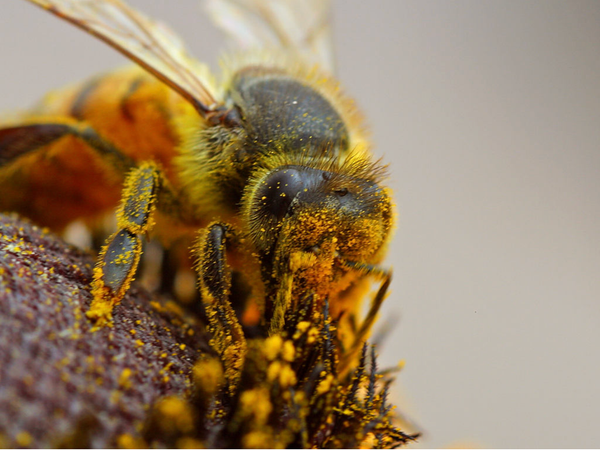
The part of this that connects most directly to something I actually study is what happens to pollinators specifically. Neonicotinoid pesticides, a class widely used in both agriculture and ordinary landscaping, don’t just kill insects outright. Research published this year in the journal Insects found that even sublethal doses of the neonicotinoid thiamethoxam disrupt hormone signaling that controls larval development in honeybee queens and drones, damage that shows up well before any bee actually dies from exposure. A separate global survey found neonicotinoid residue in 75 percent of honey samples tested worldwide, meaning most hives on the planet are carrying some level of exposure even when nobody sprayed them directly.
That’s the part campus pesticide use quietly feeds into. Ordinary landscaping chemicals, applied to keep lawns and athletic fields looking uniform, don’t stay contained to the specific patch of grass they’re sprayed on. They move through soil, through water, through the pollen and nectar bees carry back to a hive that might be nowhere near the original spray site.
Mackenzie Feldman, now project director of Re,wild Your Campus, has described the goal less as banning chemicals and more as closing what she calls a huge knowledge gap around organic land care, since most groundskeepers were simply never trained in the alternative. Schools that have made the switch, more than ten organic pilot programs nationwide by the group’s count, report keeping their campuses looking just as maintained, without the chemical dependency.
None of this started with a policy paper. It started with a volleyball coach telling his team not to touch a stray ball. Sometimes the biggest campaigns start from someone noticing something small enough that everyone else had learned to ignore it.
Sources. Feldman, M., Re:wild Your Campus; UC Berkeley grounds data; journal Insects (neonicotinoid research); global honey residue survey.