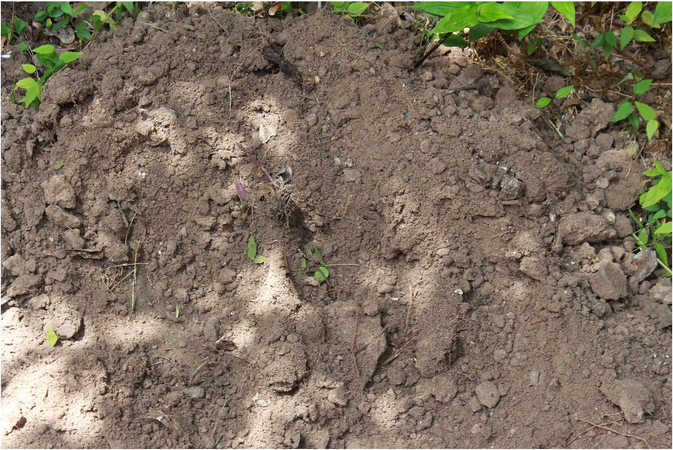
I crouched down by a garden bed recently and actually looked at the dirt instead of walking past it. Dark, crumbly, threaded with roots, a faint smell like rain. I’d always filed soil under background scenery, the stuff plants happen to sit in. It turns out that’s roughly as accurate as calling a city empty because you can’t see inside the buildings.
Kate Scow, a professor of soil science and microbial ecology at UC Davis, keeps bags of soil on her desk because she’s spent her career trying to get people to take it seriously. Her numbers are hard to process at first. A gram of soil, about a quarter teaspoon, can easily contain a billion bacterial cells, plus several miles of fungal filaments packed into that same pinch. Scow estimates a single teaspoon of healthy soil can hold somewhere between 10,000 and 50,000 different microbial taxa, and those numbers keep getting revised upward as genetic sequencing improves.
Do the math on scale and it gets stranger. A separate estimate compiled from USDA conservation data found that a teaspoon of healthy soil can contain more individual living organisms than there are people currently alive on Earth, somewhere north of eight billion. Not species. Individual organisms, in a spoonful, under a garden bed most people step over without a glance.
Noah Fierer, a microbiologist at the University of Colorado Boulder, has spent years trying to open up what he calls the black box of soil microbes. Scientists don’t even have names for most of the organisms living down there, let alone descriptions of what they do or how they survive. Fierer says these microbes do enormous amounts of work for us, directly and indirectly, building fertile soil, helping plants grow, cycling carbon dioxide and oxygen, mostly anonymously, and he hopes they eventually get, in his words, the respect they deserve.
That work isn’t abstract. Kristen DeAngelis, a microbiology professor at UMass Amherst, studies how soil microbes convert organic matter, fallen leaves, rotting wood, dead grass, into stable soil carbon instead of letting it drift back into the atmosphere. She put the scale in a comparison I haven’t been able to shake, there are a trillion times more microbes in a teaspoon of soil than there are stars in the known universe. And yet, she says, we still don’t know that much about them.
None of this means every patch of dirt is equally alive. Researchers are clear that tillage breaks up fungal networks, bare exposed soil swings harder between wet and dry, and compacted or heavily disturbed ground supports far less life than an undisturbed garden bed or grassland. A parking lot and a forest floor are not interchangeable just because both are technically soil. The organism count depends entirely on how the ground has been treated.
What actually changed for me wasn’t a single fact. It was realizing that what I’ve spent years calling dirt is closer to an entire uncatalogued civilization, doing chemistry I can’t see, at a population density I can’t picture, every single time I’ve stepped on a lawn without noticing. I’m not sure I’ll be able to look at a garden bed the same way again.
Sources. Scow, K., UC Davis; Fierer, N., University of Colorado Boulder; DeAngelis, K., UMass Amherst; USDA conservation data.