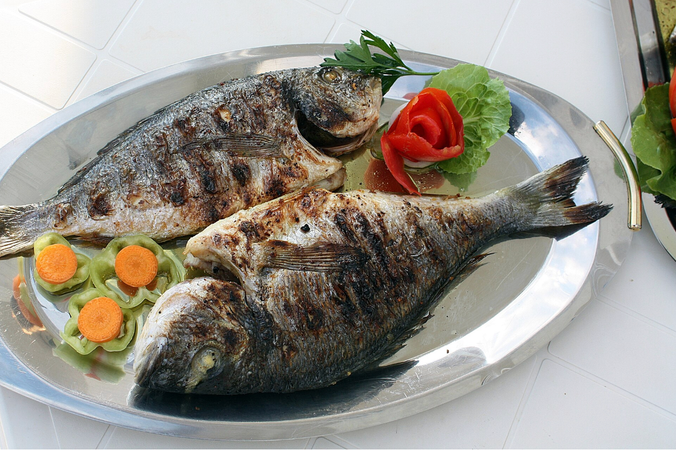
Steamed fish, rice, and stir fried bok choy. That’s my go to dinner. Simple, healthy, nothing fancy. So when I sat down to calculate the water footprint of that exact meal, I expected a decent number. I did not expect almost 3,700 liters.
Here’s how it broke down. The fish alone, about 200 grams of sea bass, came out to roughly 3,400 liters. The rice added another 250. The bok choy barely registered, about 40 liters for a full cup. The fish wasn’t just the biggest part of the meal’s footprint. It was basically the entire footprint. Everything else was rounding error next to it.
That surprised me because I’d always filed fish under the healthy, lighter footprint category, somewhere between chicken and vegetables in my head. I was wrong, but I was also wrong in a more specific way than I first realized.
Dr. Jessica Gephart, an environmental scientist at American University who studies the footprint of seafood, has a distinction that changes this whole picture. Wild caught fish, the kind pulled straight from the ocean, uses almost no freshwater at all. The boat doesn’t need irrigated cropland. The fish doesn’t need years of freshwater feed. As she put it, capture fisheries require essentially no freshwater inputs. The massive water numbers, the ones that rival or beat beef, come from farmed fish, aquaculture, where the fish are raised on land based operations and fed crops that were grown with irrigated water. One review out of Sweden found that farmed fish in China can range anywhere from 2,000 to 57,000 liters per kilogram depending on the species and the farm, some of the higher estimates landing well past what it takes to raise a kilogram of beef.
So the number I calculated wasn’t really about fish in general. It was almost certainly about farmed fish, since that’s what shows up at most grocery stores and what most footprint calculators default to. A wild caught version of the same dinner might have looked completely different. I had no way to know which one I actually ate, because nothing on the package said.
That’s the part that annoys me more than the number itself. I can’t make an informed choice about something I can’t even identify. Farmed or wild changes the footprint by a factor of ten or more, and there’s no label at my grocery store telling me which one is on the plate.
I did look at some swaps anyway. Replacing the fish with tofu drops the protein’s footprint to around 120 liters, a fraction of what farmed fish costs. Swapping the bok choy for cabbage saves a little more. Cutting the rice down and adding a slice of bread instead saves a bit too, though rice was never the real problem here.
I’m not giving up fish. I just want to know what kind I’m buying, and right now I can’t. Until grocery stores start labeling farmed versus wild the way they label organic or cage free, I’m stuck guessing at a number that could be ten times bigger or smaller depending on something nobody tells me.
Next time I’m at the fish counter, I’m going to ask. Probably for the first time in my life.
Sources. Gephart, J., American University (seafood water footprint research); farmed vs. wild-caught fish water footprint review, Sweden.