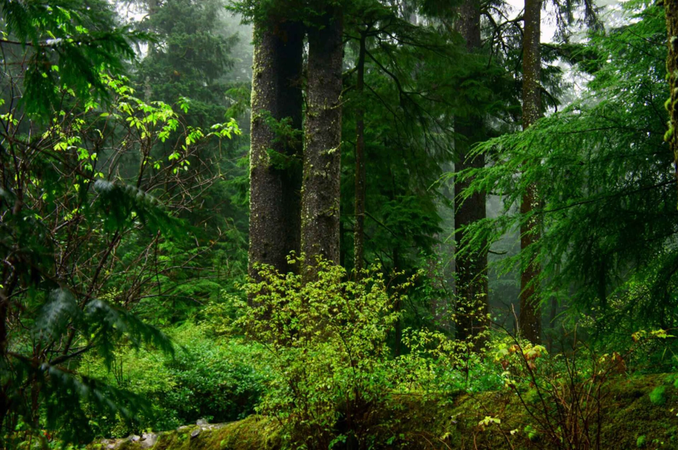
I researched California’s old growth forest protections this week and found a specific case that made an abstract policy question concrete. Jackson Demonstration State Forest, 48,652 acres of coast redwood in Mendocino County, doesn’t currently count toward California’s 30×30 conservation goal, even though it’s state owned land.
It doesn’t qualify because the forest is still managed as commercial timberland, with timber harvest plans sold to logging operations most years. Harvesting of the oldest first growth trees has stopped in recent years, which is a meaningful shift. But mature second growth trees, some more than a hundred years old, are still harvested in a forest that’s also home to endangered coho salmon and the northern spotted owl.
I also had to correct a number I’d been repeating without checking. I’d assumed California was still stuck near 17 percent land protection under the 30×30 framework. That’s out of date. As of June 2025, California has conserved 26.1 percent of its lands, according to the state’s own progress report, up from about 24 percent when the initiative launched in 2020. That’s real, measurable progress, even if it’s not the full 30 percent yet, and even if places like Jackson Demonstration still sit outside the count.
The gap between a forest being state owned and a forest being counted as conserved comes down to how the land is actively managed, not just who holds title to it. A parcel harvested for timber on a regular rotation and a parcel set aside for ecological protection can both technically belong to the state, while representing very different outcomes for the plants and animals living there.
Redwood forests specifically play an outsized role in carbon storage among California ecosystems, storing more carbon per acre than almost any other forest type in North America, largely because of how long individual trees live and how much biomass accumulates in old growth stands over centuries. That makes the management status of a forest like Jackson Demonstration matter for reasons beyond its immediate wildlife value.
California’s 30×30 progress shows the state is capable of real gains when land is formally set aside. The next question worth tracking is how many more acres of already publicly owned forest could shift from active commercial rotation into counted conservation status without a single new acre changing hands.