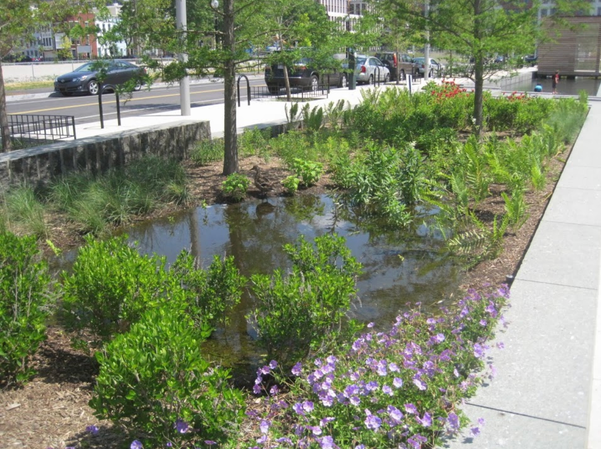
There’s a corner of the Campbell Civic Center parking lot near me that does nothing except get hot. No shade, no drainage, no purpose beyond holding a few extra cars on the busiest days. I started sketching out what would happen if that roughly 2,500 square foot corner became something else entirely, and the more I researched, the more the idea stopped feeling like a stretch.
The model I kept coming back to is Brilliant Detroit, a nonprofit that has spent the past several years turning vacant lots in Detroit neighborhoods into small parks, some under half an acre, built specifically in areas that had little green space to begin with. Cindy Eggleton, the organization’s co-founder and CEO, has described the goal in terms that stuck with me, these become beautiful spaces in the middle of neighborhoods, hubs where people can play, raise kids, and actually gather, not just pass through. The organization built four of these pocket parks by 2022 and has kept expanding since, aiming for one at every location it operates.
What makes the Detroit model relevant here isn’t the acreage. It’s the proof that you don’t need a lot of land to change how a block feels. A quarter acre corner lot, done right, functions completely differently than the same quarter acre paved over and empty.
For the Campbell version, three elements do most of the actual environmental work. Native plants, things like California poppies, sages, and milkweed for monarchs, need roughly 75 percent less water than a lawn once established, according to widely cited native landscaping research, which matters directly in a state that budgets water carefully most years. Shade trees, three or four native oaks or sycamores, can lower surface and air temperature in their immediate area by a documented 10 to 15 degrees Fahrenheit, according to urban forestry heat island research, a meaningful number during the kind of heat waves Silicon Valley has been getting more of. And a rain garden or bioswale, a shallow planted depression designed to catch runoff instead of sending it straight to a storm drain, filters pollutants out of parking lot runoff before it reaches the watershed at all, rather than after the fact.
None of these three technologies are experimental. Rain gardens specifically trace back to 1990, when a developer named Dick Brinker, working on a Maryland subdivision, proposed replacing a standard stormwater retention pond with a planted bioretention area instead. The idea worked well enough that it’s now standard vocabulary in stormwater engineering, used by the EPA and cities nationwide.
The equity argument is the part I actually care most about. A quarter mile radius around that Campbell parking lot corner includes apartment buildings where residents don’t have yards, and a school, and a stretch of downtown. Green space in a lot of cities correlates directly with income, wealthier neighborhoods get parks, denser and lower income neighborhoods get parking lots. A pocket park doesn’t fix that citywide, but it does put a specific, concrete dent in it, in one specific place, for the people who currently walk past hot asphalt on their way to an apartment with no outdoor space of their own.
I’m not naive about the gap between a design sketch and an actual built park. Brilliant Detroit’s timeline for even a small lot ran years, not months, and required real fundraising, real permitting, real community input at every step. But the fact that a corner lot in Detroit can become a functioning park with benches, native plants, and a bioswale means the same is at least physically possible here. Somebody has to be the first to actually propose it to the city. I’d rather that be a sketch on paper than nothing at all.
Sources. Eggleton, C., Brilliant Detroit; native landscaping water-use research; urban forestry heat island research.