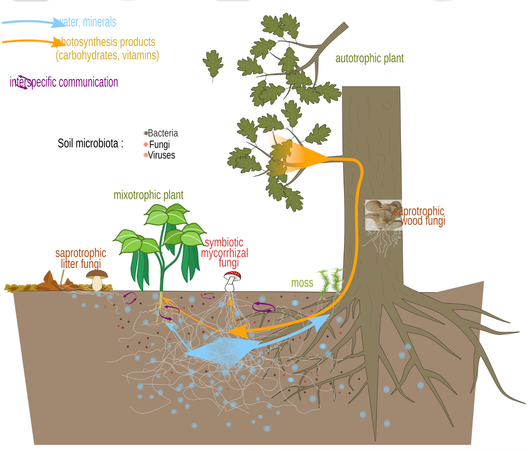
I designed a school resource sharing program this week explicitly modeled on the wood wide web, the idea that trees in a forest share water and nutrients through underground fungal networks, with older hub trees supporting younger ones. It’s one of the most viral science metaphors of the last decade. It’s also, as of the past few years, at the center of a genuine, unresolved fight inside forest ecology.
The concept traces back largely to Suzanne Simard, a forest ecology professor at the University of British Columbia, whose research beginning in the early 1990s found that fungal networks could connect trees of different species, and whose bestselling memoir Finding the Mother Tree popularized the idea of hub or mother trees distributing resources to support seedlings. Her work has real scientific grounding and real influence on how people think about forests.
In February 2023, a citation review published in Nature Ecology and Evolution, co-authored by Justine Karst, a mycorrhizal ecologist at the University of Alberta, along with Melanie Jones and Jason Hoeksema, challenged how far the popular version of the theory has been pushed beyond what the underlying data actually supports. Karst told CBC News she’s specifically questioning the claim that these networks are widespread throughout forests at all, pointing out that the foundational research covers only a couple of forest types, primarily Douglas fir stands in British Columbia, not forests broadly. The review’s title states the concern directly, positive citation bias and overinterpreted results have led to what the authors call misinformation about common mycorrhizal networks.
Simard has defended her work publicly, telling CBC that the critique focuses on a narrow slice of a much larger body of research and that studying how trees interact remains essential to protecting forests. She and colleagues later published a detailed rebuttal to the critics. This isn’t a case of one side being obviously right. It’s an active, unsettled scientific argument between credentialed researchers, playing out in peer reviewed journals in real time.
A separate 2023 review in Trends in Plant Science went further, arguing that the mother tree concept in particular risks what the authors call plant personification, describing forests using language of altruism and intention that may not be scientifically supported, and that popular books by Simard and forester Peter Wohlleben have spread that framing faster than the scientific community has been able to evaluate it.
None of this means my resource sharing program’s underlying metaphor is fake. Mycorrhizal networks are real, well documented structures. What’s contested is specifically how widespread they are across forest types, and how much of the altruistic, coordinated resource sharing behavior gets read into the data versus actually demonstrated by it, the kind of interpretation gap that happens easily when a scientific finding becomes a bestselling metaphor.
I’m keeping the program. I’m changing how I describe the science behind it, from settled fact to an idea real scientists are still actively arguing about. That distinction matters more to me now than it did a week ago.
Sources. Simard, S., University of British Columbia; Karst, J. et al., published in Nature Ecology and Evolution (2023); Trends in Plant Science (2023 review).